

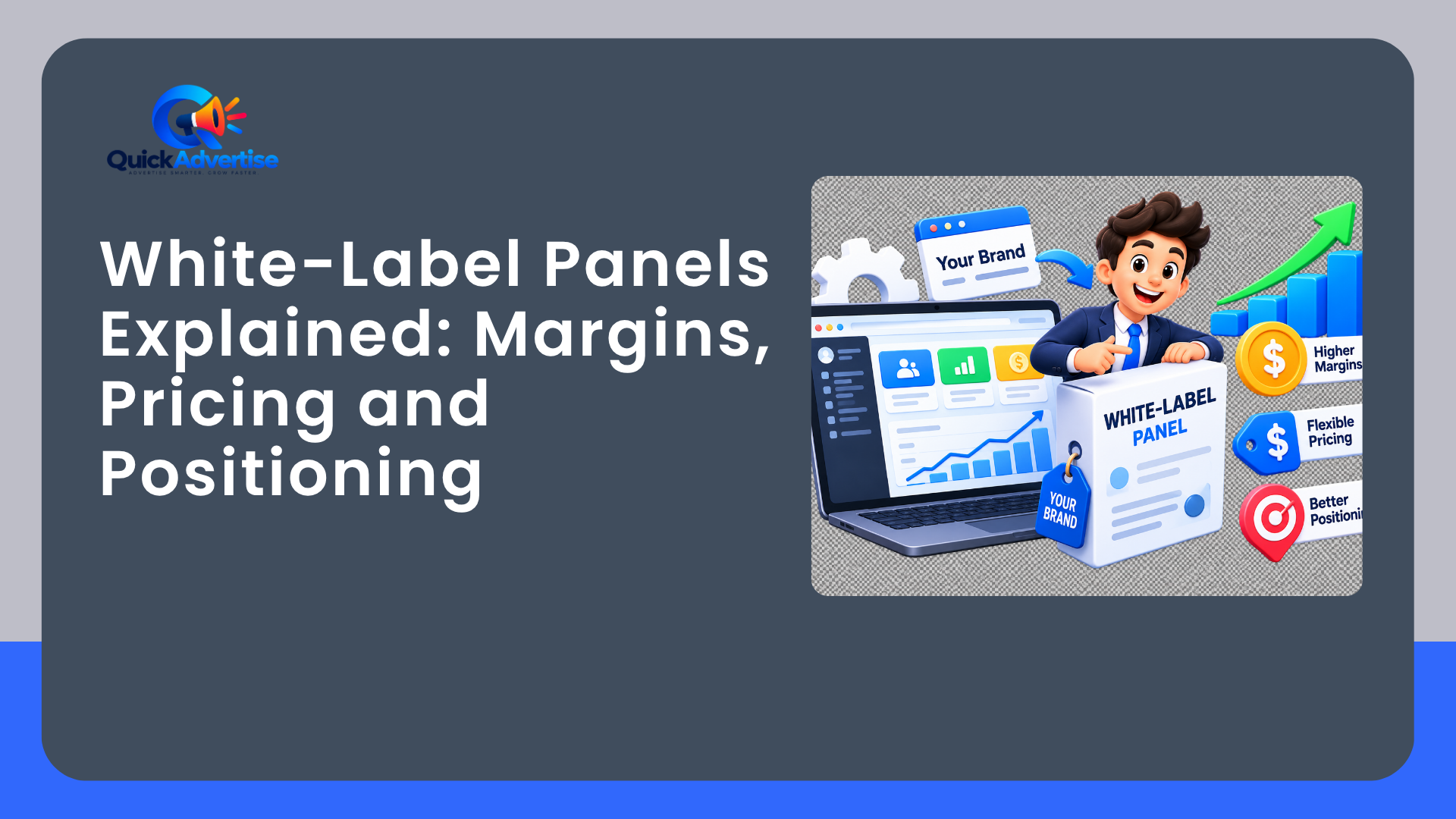
If you sell social media growth services to other people, at some point you stop delivering every order yourself and start buying from a white-label SMM panel. The phrase gets used loosely, but the idea is simple: a supplier lets you put your own brand on the service and resell it at your own price. This guide breaks down what a white-label panel actually is, how reseller margins are really calculated, the pricing models you will meet, and how to position your brand so you are not just the cheapest name in a crowded market.
What a White-Label Panel Actually Is
A white-label panel separates two layers that most buyers never think about: the supply layer and the brand layer. The supplier owns the delivery infrastructure — accounts, providers, capacity. You own everything the customer sees: the domain, the dashboard, the pricing, the support voice and the client relationship.
- You control: your storefront and branding, your price list, your refund and refill policy, your customer support, and your client list.
- You do not control: the underlying delivery network, its capacity at peak times, or the platform-side behaviour of the service you resell.
- Not the same as: a plain reseller account (panel branding, you just buy at tier pricing) or an affiliate referral (someone else keeps the customer).
The practical consequence: your reputation rests on a supply chain you do not run, so supplier selection is a margin decision and a risk decision.
How Reseller Margins Really Work
Gross margin on a service line is straightforward:
(your price per 1,000 − panel cost per 1,000) ÷ your price per 1,000
Illustrative example only: if your panel costs you 40 per 1,000 units and you sell at 120 per 1,000, your gross margin is 66.7%. On a 10,000-unit order that is 1,200 in revenue, 400 in cost, and roughly 800 in gross profit.
Two levers move that number: raising price or lowering cost. Cutting price to win volume compresses margin, and volume rarely rescues a thin one — a 10% margin on triple the orders is still a 10% margin, now with triple the support load.
Then subtract the costs that never appear on the panel invoice: payment gateway fees, refunds and refills you honour, support time, and dispute or chargeback exposure. What is left is net margin, and it is almost always lower than the headline figure. Track margin per service line, not blended across the whole catalogue, or a single loss-making service will quietly fund itself out of your profitable ones.
Pricing Models You Will Meet
- Per-1,000 unit pricing — the standard. Everything else is a modifier on top of it.
- Quantity tiers and minimums — cost per unit usually falls at higher volume steps; most panels set a minimum order size.
- Speed tiers — instant delivery versus drip-feed over hours or days, priced differently depending on the supplier’s capacity model.
- Refill guarantees — a stated window and set of conditions under which a drop is topped up. Read the conditions; they decide whether the guarantee is real.
- Prepaid wallet versus per-order invoicing — prepaid credit is cheaper and faster but ties up cash and can expire.
- API access and white-label dashboard fees — some suppliers charge for API access or a minimum monthly spend before the branded panel is included.
Price the combination, not the headline rate: a cheap rate with no refill and a 30-day credit expiry can cost more than a slightly higher rate with both.
Positioning: Where a White-Label Brand Wins
If your cost is your competitor’s retail price, you cannot win on price. Position on something the supply layer does not decide for you:
- Niche depth — one platform done properly beats twenty done roughly.
- Audience fit — agencies need invoicing and volume tiers; solo creators need simple pricing and fast answers.
- Geography and language — local payment methods and support in the customer’s language are real differentiators in regional markets.
- Reliability as a claim you can prove — publish honest uptime and delivery-time figures instead of adjectives.
Avoid positioning built on promises nobody can keep. No panel can guarantee platform approval, permanent results, or an official partnership with YouTube, Meta, Google or the App Store — claims like that invite disputes, chargebacks and account trouble. Position on what you actually control: turnaround, communication, transparent policy and fair pricing.
The Operational Checklist Before You Sell
- Test one small order end to end before you advertise anything.
- Confirm the supplier’s refund, refill and downtime policy in writing.
- Write your own customer-facing terms you can actually honour, including a realistic delivery window.
- Publish a compliance note and a clear contact channel — buyers check both.
- Review cost per order monthly and re-price when your supplier’s rates move.
- Have a plan for orders you cannot fulfil; how you handle that is what customers remember.
Where QuickAdvertise Fits
QuickAdvertise runs a reseller and API partner program for exactly this model — panel access so partners can brand, price and resell across social, YouTube, app and website services, with delivery handled on our side. If you are building a reseller brand from scratch, it is a practical place to start rather than stitching together several unrelated suppliers. For pricing and partner terms, use the contact page.
Engagement services sit inside each platform’s Terms of Service and, depending on your market, consumer-protection rules on undisclosed paid promotion — confirm your own use case with a legal adviser if unsure.
Start narrow: one service, one audience, thirty days of real numbers on cost, refunds and support time. Once that line has a margin you can defend, add the next one. If you want the longer version of how we think about pricing and positioning for resellers, the QuickAdvertise newsletter is where we publish it.