

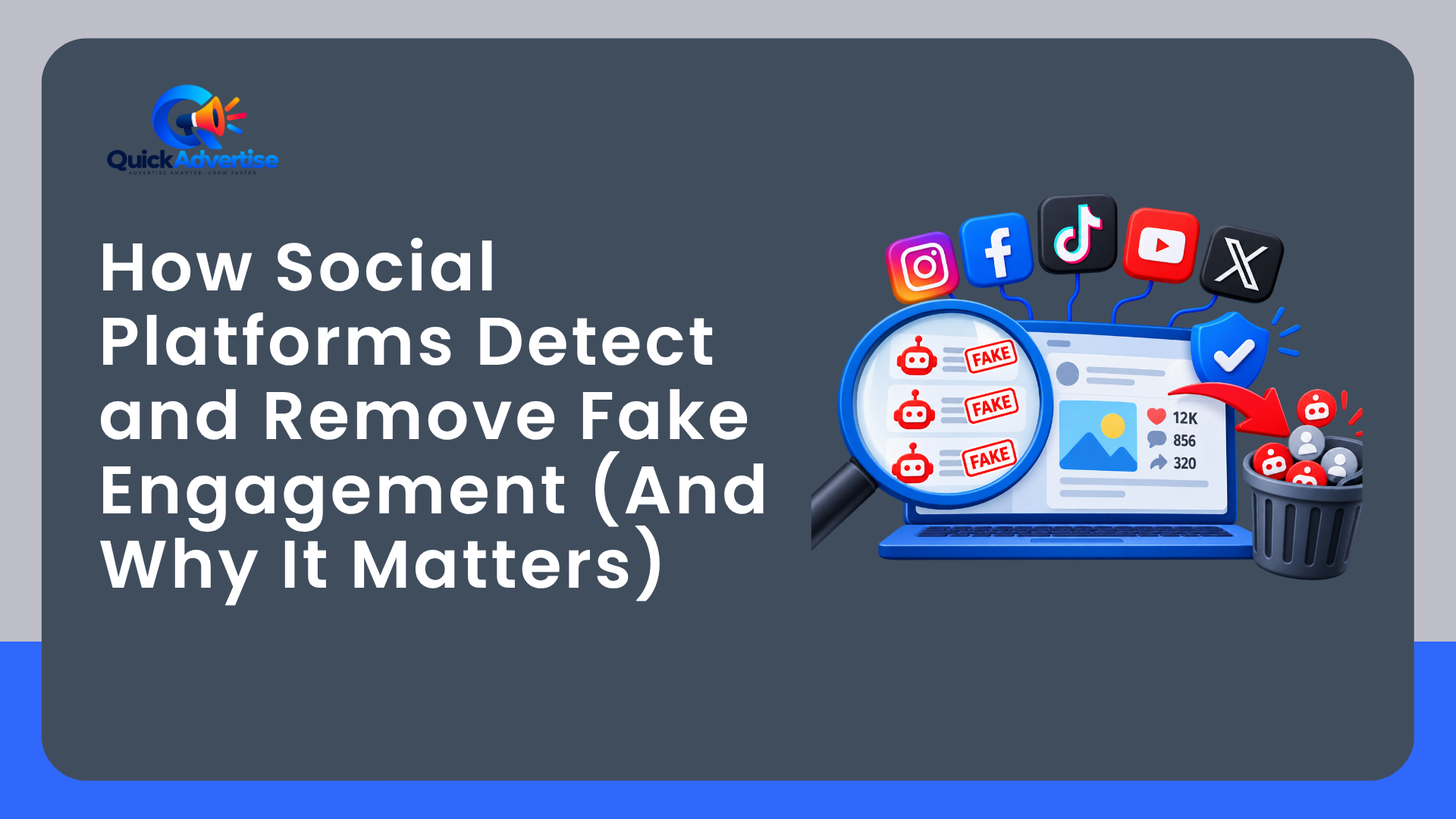
Every platform that hosts public metrics — YouTube, Instagram, X, TikTok, the app stores — has quietly become a fraud-detection operation. Behind the simple numbers your profile displays sits a stack of systems whose entire job is to decide whether the engagement in front of them came from real people. For anyone buying or selling growth, understanding how that detection works is not a technical curiosity. It is the difference between a strategy that compounds and one that gets quietly erased.
This guide explains the signals platforms monitor, how detection has evolved, what removal actually looks like, and what it means for your growth plan.
Why platforms invest so heavily in detection
Fake engagement is not a victimless grey area. It corrupts the signals platforms use to decide what to recommend, which ads to serve, and how to price inventory. If follower counts and view counts can be manufactured cheaply, then every ranking decision built on those numbers becomes unreliable — and advertisers, who fund most of these platforms, stop trusting the data they are buying against.
That commercial incentive is why enforcement is persistent rather than occasional. Platforms do not need to catch every instance to make fake engagement a bad investment; they only need to make it unreliable enough that the money spent on it is wasted.
The signals platforms actually monitor
No single signal proves fraud. Detection works by combining many weak signals into a confidence score. The categories that matter most:
- Device and network fingerprints. Thousands of accounts operating from the same device identifiers, emulators, or a small set of IP ranges is a strong clustering signal. Datacentre and VPN ranges are treated with particular suspicion because genuine viewers rarely arrive from them at scale.
- Behavioural patterns. Real users scroll, pause, skip, and abandon. Accounts that follow identical action sequences, act at machine-like intervals, or interact with content they never watch behave nothing like humans, and models are trained specifically to spot that gap.
- Velocity and spikes. A video that gains a large share of its lifetime views in a few minutes, with no matching rise in impressions from normal sources, stands out against the platform’s own baseline for that account and niche.
- Engagement ratios. Views without watch time, follows without profile visits, and likes without comments all point to the same conclusion. The ratios matter more than any single number.
- Account graph analysis. Following networks, comment threads, and shared creation patterns reveal clusters of accounts that exist mainly to boost one another. Graph analysis finds these groups even when individual accounts look plausible in isolation.
- Content and language quality. Duplicated comments, generic praise, and mismatched language or timezone signals are classic markers of coordinated inauthentic activity.
How detection moved from simple rules to machine learning
Early anti-spam systems were rule-based: rate limits, blocklists, and manual review. Those were easy to route around, which pushed platforms toward supervised and unsupervised machine learning. Modern classifiers are trained on labelled examples of confirmed fake activity, then applied continuously to new data, so the system improves as it sees more attempts.
Unsupervised methods — clustering, anomaly detection, and graph learning — matter just as much, because they can flag coordinated behaviour that no rule anticipated. The practical consequence is that detection is adaptive. Whatever pattern worked last year is, by design, the pattern most likely to be modelled this year.
What removal looks like in practice
Enforcement is rarely a single dramatic ban. More often it is a quiet reversal:
- Metric purges. Platforms periodically strip out engagement they judge inauthentic. Counts drop, sometimes sharply, with no notification.
- Reduced distribution. Content associated with suspicious activity can be throttled in recommendations, so reach falls even when the visible numbers still look intact.
- Monetisation and eligibility impact. Platforms such as YouTube can withhold monetisation or program eligibility from channels found to have inflated metrics.
- Account actions. Repeat or coordinated violations can escalate to warnings, feature limits, or suspension — and in the app stores, to listing removal.
Because these actions are cumulative and often silent, the true cost of fake engagement is usually paid months later, when a channel is trying to qualify for monetisation or a brand is trying to prove results to a client.
What this means for creators and brands
The honest takeaway is that fake engagement is a poor investment on its own terms, before you even get to the ethical question. If the platform’s systems are designed to neutralise exactly the activity you paid for, the money is not buying durable growth — it is buying a temporary number that will be corrected.
It also creates a second-order problem: metrics you cannot trust make it impossible to learn what is actually working. A channel padded with artificial views cannot tell you which thumbnail, title, or hook genuinely resonates, so the feedback loop that should guide your next decision is broken.
Boosting reviews or ratings may conflict with the Terms of Service of the platform involved and, depending on your market, with consumer-protection rules on undisclosed paid endorsements (e.g. the US FTC’s rule on fake reviews) — confirm your own use case with a legal adviser if unsure.
A more durable way to think about growth
Platform enforcement is heading in one direction: toward rewarding authentic, disclosed engagement and removing everything else. The resilient strategy is to treat any paid push as a supplement to content that already earns real attention — stronger positioning, better packaging, and a clear reason for someone to follow — rather than as a substitute for it.
Where promotion genuinely helps is in getting real content in front of real people faster, so the platform’s own algorithms have enough signal to work with. That is the framing QuickAdvertise takes: promotion as distribution, not as fabricated social proof. You can see how we scope and describe our promotion services on the social media promotion page, and compare that against your own platform’s rules before you spend anything.
If you want to keep up with how these detection systems and platform policies change, the QuickAdvertise newsletter breaks them down in plain language — what the platforms actually say, and what it means for your growth plan. No hard sell and no inflated promises.