

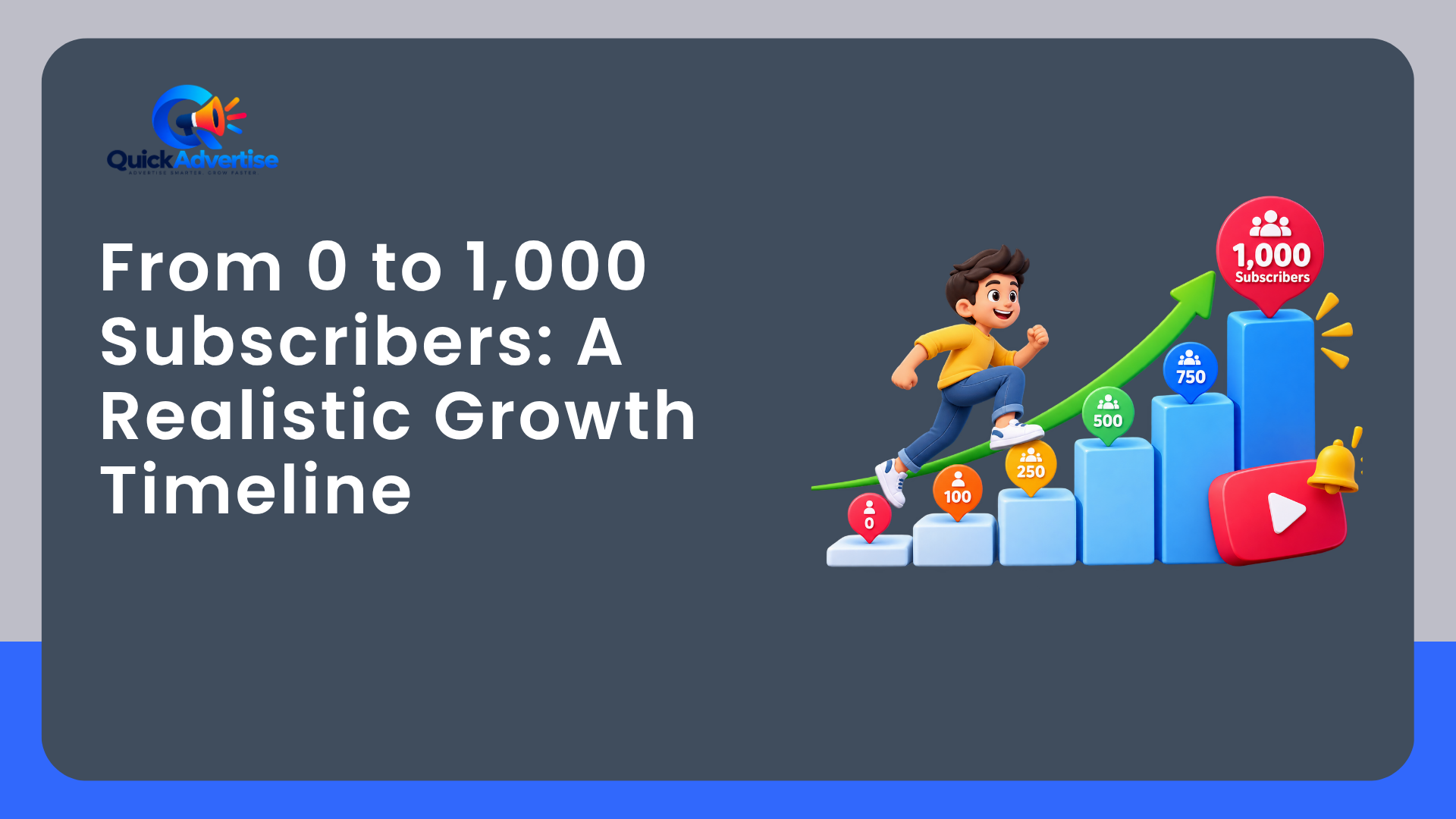
Why “How Long to 1,000 Subscribers?” Has No Single Answer
Search any creator forum and you will find two kinds of answers to the same question. One says “I hit 1,000 in six weeks.” The other says “I’ve been uploading for two years and I’m at 480.” Both are true, and neither is a benchmark you can plan against.
Subscriber count is a lagging indicator. It is the residue left behind by three things: how much distribution your videos actually get, how well those videos convert viewers into repeat viewers, and how consistent you are about showing up. A channel with 300 views per video and a strong return-viewer rate will cross 1,000 subscribers faster than a channel with 3,000 views per video and a weak one. The number at the top of the channel page hides all of that.
So instead of asking “how long,” the more useful question is: what has to be true at each stage for the next stage to happen? That is what a realistic timeline actually looks like.
The Four Phases of a 0-to-1,000 Timeline
Across channels that do reach 1,000 subscribers, the shape of the journey tends to repeat, even when the calendar doesn’t. Treat these as phases, not deadlines.
- Phase 1 — Calibration (roughly the first 10–20 uploads). You are not building an audience yet; you are building a feedback loop. The goal is to find out which topics, thumbnails, and title formats your channel can actually get shown for. Expect low numbers. Expect several videos that get almost no impressions.
- Phase 2 — Signal (once a repeatable format emerges). One or two videos start outperforming the rest. Your job here is to recognise what made them work and deliberately repeat the pattern rather than chasing novelty. This is usually where the first few hundred subscribers arrive, and where most people quit early because the growth still feels random.
- Phase 3 — Compounding (100 to roughly 700). The channel starts recommending your own back catalogue to new viewers. Return viewers rise, and each new upload benefits from the audience the previous ones built. Growth per video becomes less dependent on a single lucky upload.
- Phase 4 — Cross-over (the final stretch to 1,000). Subscribers arrive from search, suggested placement, and external shares at the same time. The last 300 usually come faster than the first 300 — but only if the previous three phases actually happened.
The single most common failure is skipping Phase 1. Creators who upload twenty unrelated experiments and then wonder why nothing compounds have not built a signal; they have built a portfolio of one-offs.
What Actually Moves the Number at Each Stage
The levers change as the channel matures, and using a late-stage lever too early wastes effort.
- Early (0–100): topic clarity and title discipline. Pick a subject narrow enough that the platform can tell who to show your video to. A channel about “video editing” competes with everyone; a channel about “editing vertical product clips for small e-commerce brands” does not.
- Mid (100–500): retention and packaging. Watch where viewers leave. If the first thirty seconds lose half the audience, no amount of promotion will fix the subscriber conversion, because paid or promoted views convert at the same weak rate as organic ones.
- Late (500–1,000): cadence and catalogue depth. At this point, having 40 watchable videos on a clear theme is worth more than one polished flagship upload, because the platform has more material to test against more viewer profiles.
If you want external distribution to work with those levers rather than against them, the sequencing matters: promote a video that already retains well, not one you hope will. Services such as QuickAdvertise’s YouTube and video promotion deliver views and engagement, but they are a multiplier on a video that already works — not a substitute for one that doesn’t. Promotion pushes a video in front of more people; it does not change how many of them choose to stay.
Measure These Instead of the Subscriber Count
Subscriber count updates slowly and moves for reasons you can’t see. These four numbers tell you whether you are actually on a 1,000-subscriber trajectory.
- Returning viewers as a share of total. If this is rising month over month, your audience is forming. If it is flat while views grow, you are renting attention, not earning it.
- Average view duration trend, per format. Compare like with like. A drop across every format means the topic is drifting; a drop in one format means the format is failing.
- Subscribers per 1,000 views. This is your conversion rate. Improving it is usually cheaper than doubling traffic.
- Upload consistency over the last 90 days. Not perfection — consistency. Channels that publish on a predictable rhythm give the platform more chances to find them.
Common Timeline-Breakers
Most stalled channels are not stalled because of the algorithm. They are stalled because of one of a small set of fixable problems.
- Topic drift. Every pivot resets the signal the platform has built about who your videos are for.
- Packaging mismatch. A great video with a vague thumbnail and a clever-but-unclear title gets impressions and no clicks. The video is fine; the shopfront is not.
- Chasing a viral outlier. One video that over-performs in a topic you don’t want to make again sends a confusing signal and pulls in an audience that will not return.
- Buying subscribers. Purchased subscribers do not watch, which depresses your engagement ratios and makes every future upload harder to distribute. There is no version of this that helps a channel reach 1,000 real subscribers faster.
- Quitting inside Phase 2. The gap between “this occasionally works” and “this reliably works” is where most channels stop — usually a few uploads before the compounding starts.
What We Won’t Tell You About the Timeline
You will find services that promise a specific subscriber count within a specific number of days. Be careful with those. Nobody can guarantee an organic milestone date, because the date depends on decisions the platform makes about your content, decisions no vendor controls. What a legitimate promotion service can do is increase the number of people who see a video you have already made well. That changes the slope of the curve. It does not set the finish line.
If you are planning your own path from zero, the honest version is this: build the feedback loop first, find the format that repeats, then add distribution once you have something worth distributing. That sequence is slower to start and far faster to finish.
For a deeper look at how promotion fits into a channel that is already working, see our refill guarantee policy and the social media promotion services. And if you want the realistic-expectation version of growth planning delivered as we publish it, the QuickAdvertise newsletter is free to join.